
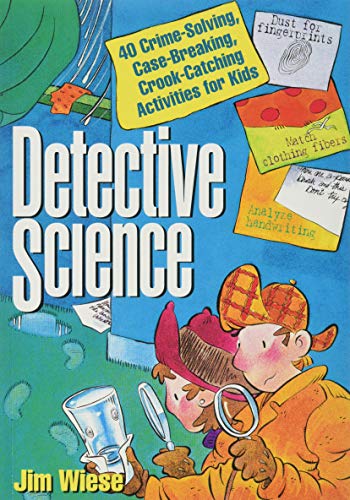
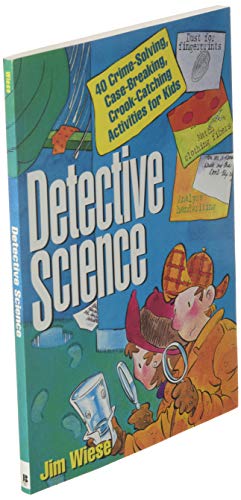
Detective Science: 40 Crime-Solving, Case-Breaking, Crook-Catching Activities for Kids
$9.99


Price: [price_with_discount]
(as of [price_update_date] – Details)
[ad_1]
Children/Science
Become a super science sleuth with . . .
Detective Science
40 Crime-Solving, Case-Breaking, Crook-Catching Activitiesfor Kids
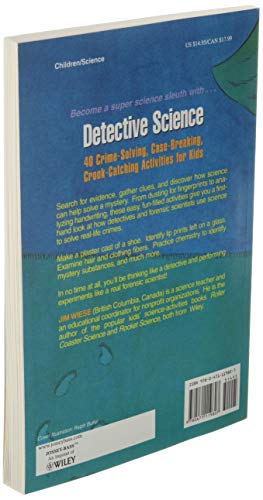
Search for evidence, gather clues, and discover how science canhelp solve a mystery. From dusting for fingerprints to analyzinghandwriting, these easy, fun-filled activities give you a firsthandlook at how detectives and forensic scientists use science to solvereal-life crimes.
Make a plaster cast of a shoe. Identify lip prints left on aglass. Examine hair and clothing fibers. Practice chemistry toidentify mystery substances, and much more.
In no time at all, you’ll be thinking like a detective andperforming experiments like a real forensic scientist!
From the Publisher

During the investigation of a crime, law enforcement officials collect evidence. This evidence, along with witness statements, is later used in courts to prove that a crime was committed and to convict the person or persons responsible for committing that crime. To convict means to find guilty, in a court of law, of committing a crime.
In 1910 at the University of Lyons, Edmond Locard first recognized the value of evidence to solve crimes and convict criminals. He developed a theory about evidence called the contact trace theory. This theory states that criminals will always take with them a trace of something from the scene of the crime, and will always leave behind some trace of having been there. The contact trace theory is the foundation of forensic science. The job of forensic science investigators is to locate the trace evidence, subject it to analysis and comparison in a forensic science laboratory, and then use all of the evidence to figure out what happened at the scene of a crime.

Experiment: Lip Prints
Women who wear lipstick often leave lip prints on drinking glasses. At a crime scene, this kind of print would be collected as evidence during an investigation. Try the following activity to learn how lip prints can be used to solve crimes.
Procedure:
Put lipstick on both of your lips and rub them together to spread the lipstick evenlyFold the white paper in halfPlace the folded paper between your lips and firmly press your lips against it being careful not to slide your lips along the paper and smudge the printRemove the paper and unfold itWrite your name on the paper to identify the lip print as yours Analysis:
Examine your lip print. What do you notice about it? Are there any unique qualities that would let you identify it as yours?
Materials: Lipstick – dark colors work best White paper Pen or pencil
Up for a challenge?
Collect lip prints from several helpers. Make sure that you write each person’s name next to his or her prints. Leave the room and have one of your helpers make a lip print on a drinking glass.
Can you identify who made the print?
There are many ways to identify a person. One of them is cheiloscopy, or the study of lip prints. (The term cheiloscopy comes from the Greek word cheilos, meaning “lip.”) Lip prints are unique and do not change during a person’s life. Although they are less commonly encountered than fingerprints at the scene of a crime, lip prints found on glasses, cups, and even letters can be valuable evidence. One problem with lip prints is that their credibility has not yet been established in courts of law.
Lip prints are commonly classified into eight patterns. Four of the most common patterns are shown here.
Common Lip Print Patterns


Branching Grooves
Rectangular Grooves
Diamond Grooves
Publisher : Wiley; 1st edition (Feb. 20 1996)
Language : English
Paperback : 128 pages
ISBN-10 : 0471119806
ISBN-13 : 978-0471119807
Item weight : 204 g
Dimensions : 17.53 x 1.52 x 25.15 cm
[ad_2]
User Reviews
Be the first to review “Detective Science: 40 Crime-Solving, Case-Breaking, Crook-Catching Activities for Kids”
Related Products


$9.99
There are no reviews yet.